Chief Minister addresses Startup Outreach Programme under JKCIP at SKUAST-Jammu
Urges youth to become job creators
05/03/2026
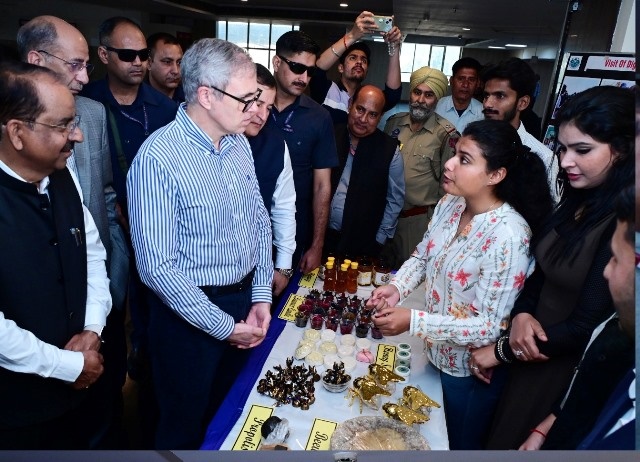
Jammu, March 05 (KIP)-Chief Minister Omar Abdullah today highlighted the immense potential of agriculture and allied sectors in Jammu and Kashmir, stating that initiatives such as the Jammu & Kashmir Competitiveness Improvement of Agriculture and Allied Sectors Project (JKCIP) are playing a crucial role in nurturing a vibrant startup ecosystem and promoting innovation-driven enterprises in Jammu and Kashmir. The Chief Minister was addressing the Startup Outreach Programme organised under JKCIP at Sher-e-Kashmir University of Agricultural Sciences and Technology Jammu (SKUAST-Jammu), jointly organised by the University and the Agriculture Production Department, Government of Jammu and Kashmir. The programme witnessed participation from Minister for Agriculture Javid Ahmed Dar, Advisor to the Chief Minister Nasir Aslam Wani, Vice Chancellor SKUAST-Jammu Dr. B. N. Tripathi, Mission Director Holistic Agriculture Development Programme (HADP) Sandeep Kumar, Director Research SKUAST-Jammu Dr. S. K. Gupta and Registrar & Dean Faculty of Agriculture Dr. Amit Kumar. The event was also attended by university faculty and staff, entrepreneurs, industrialists, startup founders and students from several colleges across the Jammu division.
Addressing the gathering, the Chief Minister emphasized that the youth must transition from being job-seekers to job-creators by harnessing innovation and entrepreneurship in agriculture and allied sectors.
Emphasizing the scope of Agriculture, CM said, “When we come to deciding what industry should be set up? What is the potential in it ? and if there is great possibility of success, then it is agriculture. And with agriculture, we decide we have to set up this type of industry."
He noted that there exists a widespread misconception that Jammu and Kashmir’s economy is driven solely by tourism. “When I tell people that in our SGDP, agriculture and horticulture are equally significant along with tourism, they get surprised. They have no idea how strong our agricultural ecosystem is. Agriculture and allied sectors like horticulture, fisheries and apiculture together form a vast economic network,” he said, adding that students today stand at a crucial juncture where they must take important decisions about their future careers.
Highlighting the limitations of government employment, the Chief Minister candidly told the students that not everyone could secure government jobs. “You all know that if I stand up and say that every one of you will get a government job, within a year I will prove myself wrong. Because the truth is that all of you cannot get government jobs. Some will, but many will not. So what will the rest do?” he asked. Explaining the region’s economic realities, he said that unlike areas endowed with resources such as coal, iron ore or oil, Jammu and Kashmir must build industries based on its existing strengths. “If we had coal under the ground or iron ore or oil like some other regions, perhaps we could have set up big factories here. But that is not our reality. We will have to build industries based on what we already have,” he said, stressing that agriculture and allied activities offer the most viable path for sustainable economic growth in the region.
The Chief Minister observed that traditional agricultural practices alone may not be sufficient to sustain livelihoods and called for a shift towards value addition and modern agricultural entrepreneurship. “There was a time when our youth were deeply connected with traditional farming, but gradually their focus shifted away because agriculture appeared uncertain. Weather disruptions, difficulties in reaching markets and other challenges discouraged many,” he said. He noted that programmes such as the Holistic Agriculture Development Programme (HADP), JKCIP and Mission YUVA have been designed to transform agriculture into a modern, value-added and technology-driven sector. “The land that we have will remain limited. In fact, agricultural land is shrinking compared to what existed twenty or thirty years ago. So the question is how do we keep agriculture viable? The answer lies in value addition, innovation and entrepreneurship,” he added.
Referring to dairy production as an example, the Chief Minister highlighted the immense scope for value addition in Jammu and Kashmir. “In Jammu and Kashmir, we process only about six to seven percent of the milk we produce. Compare that with Gujarat, where nearly ninety-three percent of milk undergoes processing and value addition. When you convert milk into products like paneer, khoya or other dairy items, you increase its value manifold,” he said. He also cited opportunities in sectors such as meat production, fisheries, honey, fruits, vegetables and floriculture. Referring to one of the award-winning young innovators, he said, “The young girl whom we felicitated today noticed that the shelf life of flowers in our region was only about three days. She simply worked on better packaging techniques, and the same flowers could now last for fifteen days. Jammu is a city of temples, and flowers will always be in demand here. This is how a small innovation can create a business opportunity.”
Encouraging students to pursue entrepreneurship without fear of failure, the Chief Minister stressed that innovation often involves risks and setbacks. “You don’t necessarily need a government job to succeed. What you need is intention, an idea and the passion to do something meaningful. After that, we, whether as a government or as institutions like this university, are here to support you,” he said. Drawing inspiration from global entrepreneurs, he remarked, “Some people get ideas even while sleeping at night. You might be inspired by entrepreneurs like Elon Musk. His rockets worth billions sometimes explode in the sky, but he does not see that as failure. He says he learns as much from the explosion as from success.” Urging the youth to overcome fear, he added, “Do not be afraid of failure. Be afraid of not trying. If you fail, we will help you rise again. Try, innovate and move forward—we are here to help you achieve success. This is my promise to all of you.”
On the occasion, the Chief Minister released four publications and felicitated two startups and two Farmers’ Producer Organisations for their achievements. He also launched 808 new Kisan Khidmat Ghars (KKGs) aimed at strengthening grassroots-level agricultural services across Jammu and Kashmir.
Earlier, the Chief Minister inspected an exhibition set up within the university premises, where he interacted with students, young entrepreneurs and representatives of Farmers’ Producer Organisations, appreciating their innovative ideas and encouraging them to transform agriculture into a modern, enterprise-driven sector.