Why Turkish and Chinese media are anti Baloch nation?
20/06/2026
By Fatima Baloch
Pakistan now faces a deepening security crisis and an existential threat. The Tehrik-i-Taliban Pakistan (TTP) and secular nationalist Baloch separatist groups such as the Balochistan Liberation Army (BLA) continue to wage high-intensity insurgencies. Additionally, rebellion in POJK and Pakistan’s brutal crackdown and killing of innocent Kashmiris have further deepened Pakistan’s internal crisis and brought it almost to a civil war.
To handle such issues, Pakistan has desperately been using foreign media tools, especially Turkish and Chinese media, and so-called biased journalists to build its own narrative against oppressed nations. Initially, Pakistan launched a global campaign desperately convincing Central Asian republics such as Tajikistan, Uzbekistan, and China that TTP is a threat to these countries, having an ideological brotherhood with the Islamic Movement of Uzbekistan (IMU) and the East Turkestan Islamic Movement (ETIM).
If these groups strengthen, they can push north, destabilizing the porous borders of Tajikistan and Uzbekistan. Logically, Tajikistan and Uzbekistan do not share borders with Pakistan. If the takeover of Kabul, Afghanistan, by TTA (Tehreek Taliban Afghanistan) on 15 August 2021 could not destabilize these countries, why would a TTP takeover harm China, Tajikistan, and Uzbekistan, where they have huge porous borders?
Further, it is to be noted that TTA-led Afghanistan has maintained good and peaceful relations with high security. The objective of this false narrative was to blackmail and mobilize these countries to further force Afghan Taliban to fight Pakistan’s war against TTP, which has been a key TTA ally during the US/NATO 20-year-long war and an ideological brother of TTA. All Pakistani false narratives and unjustified claims failed to make these countries anti-TTA-led Afghanistan.
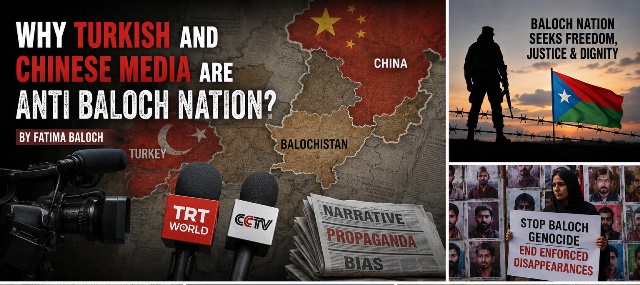
In the same way, Pakistan has been using Turkish and Chinese anti-Baloch sentiment media against BLA, which is fighting for its national identity. On 17th June 2026, Turkish media www.trtworld.com published an anti-Baloch and biased article titled “Why BLA terror is not just Pakistan's problem anymore” written by Yevgeniya Mikhailidi, where she desperately tried to convince neighboring countries that the Baloch struggle for independence will be a security risk for the world. Thank God she did not label the secular Baloch national struggle as a religious one.
In her article, she did not mention Baloch as a nation but as an ethnic group. However, the world knows Baloch is an Arab land Kurd-raced nation having its unique identity, languages, culture, and traditions. Due to Turkish enmity with Kurds, they also hate the Baloch nation being a cousin and Kurd-rooted nation. In her biased article, Yevgeniya Mikhailidi did not mention Pakistan’s cruelty on the Baloch nation, the chronology of Baloch struggle, and Pakistan’s forced occupation since 27th March 1947.
The Baloch nation knows Turkish Government and paid state-facilitated journalists are anti-Baloch due to the Kurdish angle, but educated Turkish people and common nationals support the Baloch national cause.
Being a secular, non-religious armed struggle, BLA has never been a threat to neighbors, then who to the world. The Baloch also form an integral part of Afghanistan's ethnic mosaic. Nimroz, a Baloch-majority province, remained relatively peaceful during the Soviet invasion, the civil war, and the U.S./NATO occupation. Afghan Baloch leaders consistently negotiated with influential commanders such as Ismail Khan in Herat to prevent internal conflict. These efforts helped avert wider instability during the U.S. withdrawal in August 2021. Today, Afghan Baloch reportedly hold positions within the Taliban's political and military structures, with some expressing sympathy for Baloch nationalist aspirations.
Baloch is a secular and moderate nation that has been fighting for a secular democratic Republic of Balochistan against Pakistan’s occupation since 27th March 1948. Pakistan was created by the British by dividing the Indian subcontinent in the name of religion through the so-called Two-Nation Theory. However, Balochistan was never part of the Indian subcontinent and has no similarity with Punjabis, Sindhis, and Bengalis who belonged to the Indian subcontinent. The Baloch have nothing to do with the British-sponsored Muslim League.
When British India was partitioned in 1947, the Khanate of Kalat (Eastern Balochistan) declared its independence on August 12, 1947. Following independence, Balochistan had its own parliament, consisting of an upper and lower house, with a parliamentary system. After nine months of independence, Pakistan attacked and annexed Balochistan on March 27, 1948.
Since Israel was created on May 14, 1948, Pakistan was also created in the name of religion on 14th August 1947. However, in the context of Pakistan’s massacre of Bengalis in 1970–71, the US-sponsored proxy war against Afghanistan in the 1980s, the Afghan Civil War in 1992, post-9/11 involvement as a US/NATO frontline ally against Afghan Taliban-led Afghanistan while playing a double role in the so-called War on Terror, the 1970–71 Black September conflict in Jordan against Palestinians, and later joining Saudi-led operations in Yemen from March 2015, Baloch genocide, and killings of Pashtuns, these Pakistani interventions and wars resulted in mass deaths, destruction, and humanitarian crises.
Additionally, India suffered Pakistan’s brutal proxy wars in Kashmir for 30 years, and Pakistan has always been accused of provoking communal riots in India where only common Kashmiris and Indian Muslims suffered. Unfortunately, some Muslim countries still consider Pakistan an Islamic country, and Pakistan plays the Muslim card in the Arab world. However, Pakistan has nothing to do with Islam and Muslims.
It is deeply unfortunate that much of the Arab world and the broader Muslim community remained silent during 1970–71, when Bengali Muslims faced mass killings and genocide by the Pakistani military while struggling for independence, which ultimately led to the creation of Bangladesh. Today, the Baloch nation faces a comparable tragedy following the occupation of Balochistan on 27 March 1948.
For decades, the Baloch people have been deprived of basic human rights and fundamental needs. They continue to suffer widespread repression, enforced disappearances, extrajudicial killings, and economic exploitation. Many human rights observers describe the situation as a slow and systematic genocide carried out by occupying forces.
The Arab world—particularly Saudi Arabia, Qatar, the United Arab Emirates, Kuwait, and Oman—as well as Muslim countries globally, should closely examine the suffering of the Baloch people. The Baloch nation urges all human rights activists, diplomats, and national security circles to study Baloch history and origins and to understand the legitimacy of the Baloch national cause.
We also call upon Muslim nations and the entire international community to examine the role of external powers, particularly China, in the ongoing repression in Balochistan, including allegations of involvement in human rights violations and the large-scale exploitation of Baloch natural resources without the consent of the indigenous population.
It is deeply concerning that Pakistan is often regarded as an Islamic and democratic state, despite its historical and ongoing actions that have caused immense harm to Muslim populations. These include the Bengali genocide, political manipulation and sectarian violence in the Indian subcontinent, involvement in Black September against Palestinians, repeated political and military interventions in Afghanistan, participation in prolonged wars for foreign military and financial support, the forced expulsion of Afghan refugees, and systematic repression of Pashtun and Baloch communities. Such actions have not only caused the deaths of millions of Muslims but have also severely damaged the moral standing of Islam.
n the name of humanity, justice, and the protection of the Muslim Baloch nation, we urge the Arab world and the wider Muslim community to take meaningful diplomatic, political, and humanitarian steps in support of the Baloch people. The establishment of an independent and democratic Baloch nation at the gateway of the Middle East would contribute to regional stability and serve the long-term interests of the Arab world and the broader Muslim world. The Baloch nation would remain deeply grateful for your solidarity, support, and principled action.
On Pakistan’s current security challenges in Balochistan, the leadership of the Baloch movement has gradually transitioned from traditional figures such as Nawab Khair Bakhsh Marri and Nawab Akbar Bugti to a new generation of grassroots leaders. Their stated objective remains the establishment of a sovereign and democratic Balochistan. The movement has become increasingly organized, developing technical units, an intelligence wing known as ZIRAB, drone capabilities, naval forces, and specialized units such as the Majeed Brigade, Fateh (the Special Technical Operations Force), and women’s units.
Public support continues to grow amid allegations of state repression and systemic injustice. Pakistan’s military—backed by China and Turkey—faces increasing difficulty in suppressing the Baloch insurgency. Pakistan’s tensions with Afghanistan, its internal conflict with Tehrik-e-Taliban Pakistan (TTP) and the BLA, Chinese involvement through the China-Pakistan Economic Corridor (CPEC), and disputes over Pakistan-occupied Kashmir (PoK) have further complicated the regional security environment.
Pakistan has been ranked number one on the Global Terrorism Index for the first time, following a 6 per cent increase in terrorism-related incidents, according to a report published by the Institute for Economics and Peace (IEP). This marks the first time Pakistan has topped the index as the country most impacted by terrorism, recording a score of 8.574.
Therefore, the reality is that Pakistan is facing serious challenges in Balochistan and KPK, while civil unrest in POJK has further intensified. Pakistan is now desperately hiring foreign media, especially Chinese and Turkish media, to build an anti-Balochistan and Afghanistan narrative. Turkish and Chinese governments and responsible media persons must evaluate the future and consider how relations will remain cordial if tomorrow Balochistan achieves independence after such a bitter past.
About the Author
Fatima Baloch is a senior geopolitical and regional affairs analyst who writes extensively on Afghanistan, Balochistan, and India, with a focus on regional security dynamics, insurgency movements, and South Asian strategic affairs.
Disclaimer: The views, observations and opinions expressed in above write up of KIP News are strictly author’s own. Kashmir Independent Press (kipnews.in) News does not take any onus or liability for the veracity, accuracy, validity, completeness, suitability of any of information in the above given write up. The information, facts or figures appearing in the write up in no way manifest the position, standpoint or stance of Kashmir Independent Press (kipnews.in) and the kipnews.in does not assume any encumbrance or answerability of the same. All disputes are subject to the exclusive jurisdiction of competent Courts and Forums in Jammu City Only.)
Editor
Kashmir Independent Press(kipnews.in)