IIPA organizes Prelude Conference On “Citizen Services in the Age of AI”
20/10/2026
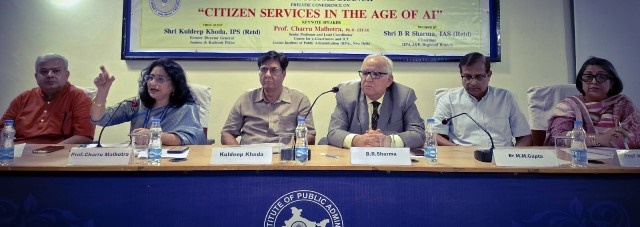
Jammu,October 20 (KIP)-The Indian Institute of Public Administration (IIPA), J&K Regional Branch, Jammu, organised a prelude conference on “Citizen Services in the Age of AI” at IIPA J & K Regional Branch.
Prof. Charru Malhotra, Senior Professor and Lead Coordinator, Centre for e-Governance and ICT, IIPA, New Delhi, delivered the keynote address. Shri Kuldeep Khoda, IPS (Retd.),former Director General of Jammu & Kashmir Police was the Chief Guest, while Shri B. R.
Sharma, IAS (Retd.), Chairman, IIPA J&K Regional Branch presided over the programme.
Prof. Charru Malhotra in her detailed presentation explored the transformative role of Artificial Intelligence in governance at the global level. She highlighted how Government of India is effective using AI in areas such as GST tax-evasion detection, biometric facial authentication, agricultural technology and digital governance services. She also drew attention to the growing use of AI in surveillance and the need to examine its implications for citizens and the State.
Emphasizing a citizen-centric approach, she discussed AI’s potential to strengthen public service delivery while cautioning against the potential risks surrounding agentic AI and the challenges associated with emerging technologies. She highlighted the importance of multi-channel service delivery system in India particularly to protect vulnerable population. She further stressed that technology must be considered alongside human values, emotional strength, spiritual grounding and philosophical traditions. Referring to inclusive AI and potential existential threats posed by advanced AI, she underlined the importance of responsible innovation, strong administrative structures, citizen charters and measurable key performance indicators (KPIs). Emphasising the principle of “human in the loop,” she
advocated meaningful human oversight in AI-enabled systems and urged that technological progress remain aligned with the public interest.
Shri Kuldeep Khoda in his address highlighted the transformative potential of AI in improving public service delivery, particularly in Direct Benefit Transfer (DBT), welfare
schemes and other citizen-centric services. He observed that AI can help address implementation challenges by improving beneficiary identification, reducing leakages and enhancing efficiency. Referring to intelligent land-record management, healthcare services such as Ayushman Bharat, AI-enabled telemedicine and personalised education, he emphasised the potential of emerging technologies to make governance more responsive and accessible. He also noted possible applications in structural analysis, drainage management and garbage disposal, where technology can support better planning and public services.
He described AI as a “double-edged sword” and called for careful assessment of its benefits,limitations and risks to ensure responsible adoption in the public interest.
In his presidential address, Shri B. R. Sharma reflected on AI’s implications for the future of governance and the aspirations of India’s youth in the context of the vision of Viksit Bharat
2047. He observed that technology can make governance more efficient, responsive and less burdensome for citizens. He cautioned against excessive dependence on AI, noting that
delegating intellectual tasks to machines without due consideration could weaken independent thinking and decision-making. He stressed the importance of retaining human intelligence, critical thinking and the courage to question AI-generated outputs rather than accepting them unquestioningly. Highlighting responsible and accountable AI adoption, Shri Sharma underlined the importance of safeguards, transparency, privacy, citizens’ rights and
accountability in AI-enabled public services. He emphasised that citizens must remain at the centre of governance, and that technology should promote inclusion and strengthen public trust. He concluded that AI should assist human judgement and improve service delivery rather than replace human responsibility, as innovation alone does not guarantee good governance.
The programme commenced with a welcome address by Er. M. M. Gupta, Director (Seminars), IIPA J&K Regional Branch. Prof. Anil Gupta conducted the proceedings, while Prof. Alka Sharma, Honorary Secretary, IIPA J&K Regional Branch, presented the formal vote of thanks. The conference was attended by members of IIPA J&K Regional Branch, senior citizens, representatives of Central Government Pensioners Welfare Associations, faculty members and students of the University of Jammu, and other civil society members.